
You've tried every cleanser, serum, and spot treatment on the market. You drink water. You wash your pillowcase. And yet — the breakouts keep coming back. Here's something most skincare routines completely ignore: what you eat is showing up on your face.
Specifically, sugar. The connection between a high-sugar diet and acne is one of the most well-studied — and most underappreciated — findings in dermatology. And it doesn't stop at breakouts. Sugar accelerates skin aging, dulls your complexion, and drives the kind of low-grade inflammation that no topical product can fix from the outside.
Let's break down exactly what's happening under the surface, and what you can actually do about it.
The Insulin-Acne Pipeline: What's Actually Happening
Every time you eat something with a high glycemic index — white bread, soda, candy, sweetened coffee — your blood sugar spikes hard and fast. Your pancreas responds by pumping out insulin to bring that glucose back under control.
That insulin spike triggers two things that are catastrophic for your skin:
1. IGF-1 Surge (Insulin-like Growth Factor)
Elevated insulin stimulates production of IGF-1, a hormone that tells your oil glands to go into overdrive. More oil means a better environment for Cutibacterium acnes bacteria to thrive. And more bacteria means more breakouts — particularly the deep, painful cystic acne that cleansers can't touch.
2. Androgen Activation
Insulin also reduces your liver's production of sex hormone-binding globulin (SHBG), which normally keeps androgens in check. With less SHBG, free androgens rise — and androgens directly stimulate sebaceous glands to produce more sebum. This is why acne often gets worse under stress (cortisol drives the same mechanism) and why it connects so directly to diet.
According to a landmark 12-week study published in the Journal of the Academy of Nutrition and Dietetics, participants who followed a low-glycemic diet saw 50% fewer acne lesions compared to those eating a high-glycemic diet. That's a more dramatic result than many prescription topical treatments.
💡 The "High-Glycemic" Foods to Watch
It's not just candy and soda. White rice, white bread, fruit juice, flavored yogurt, energy bars, and most breakfast cereals all spike blood sugar fast enough to activate the insulin-acne pipeline. Hidden sugars in everyday foods are one of the biggest triggers people miss.
Sugar and Skin Aging: The Glycation Problem
Here's the one that should make you put down the soda: sugar physically damages the collagen in your skin.
When excess glucose circulates in your bloodstream, it binds to proteins — including collagen and elastin, the structural fibers that keep skin plump and firm. This process is called glycation, and its byproducts are called Advanced Glycation End-products (AGEs).
AGEs make collagen brittle and cross-linked, meaning it can't repair or regenerate properly. The result?
- Fine lines and wrinkles appear earlier — collagen that can't renew itself shows its age
- Skin loses bounce and elasticity — it starts to sag instead of snap back
- A dull, sallow complexion — poor circulation to glycation-damaged skin shows as greyness
- Enlarged pores — weakened collagen around follicles causes them to lose their structure
The cruel irony? You can't reverse glycation damage with skincare products. No retinol or vitamin C serum gets deep enough to fix cross-linked collagen. The only effective intervention is reducing the glucose supply that causes it — from the inside out.
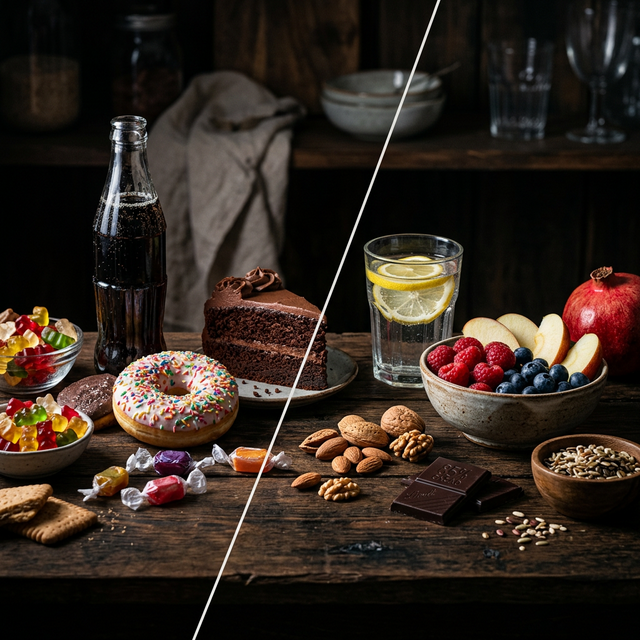
Sugar and Skin Inflammation: The Root of Most Skin Problems
Acne and aging are the headline effects — but the underlying mechanism is broader: sugar drives systemic inflammation. And inflammation is at the root of eczema, rosacea, psoriasis, and even delayed wound healing.
High-sugar diets promote the production of pro-inflammatory cytokines, which circulate throughout the body — including to the skin. This creates a low-grade inflammatory state that makes existing skin conditions worse and new ones more likely to develop.
This is also why gut health influences skin health so directly — the gut microbiome is a major regulator of systemic inflammation, and sugar feeds the bacteria that promote inflammation while starving the ones that keep it in check.
What the Research Shows
A 2020 study in JAMA Dermatology found that people who drank two or more sugary drinks per day had a significantly higher prevalence of acne compared to non-consumers, even after controlling for other dietary factors. Another study from Harvard found that a low-glycemic diet reduced inflammatory biomarkers by 25% — the same biomarkers that show up elevated in chronic acne sufferers.
Track the Sugar That's Affecting Your Skin
Can't see the connection between your diet and your skin? SugarWise makes it visible. Log what you eat and watch your sugar intake in real-time — most people are shocked by how much hidden sugar they're actually consuming daily.
The 6-Week Skin Reset: What to Do
Good news: skin is one of the fastest-responding organs when you change your diet. Here's the practical roadmap:
Week 1-2: Eliminate the obvious culprits
Cut out sweetened drinks (soda, juice, flavored coffee), candy, pastries, and white bread. These are your highest-glycemic offenders and removing them alone can trigger early skin improvements. Use nutrition label reading to spot hidden sugars in things you wouldn't expect.
Week 3-4: Swap, don't just eliminate
Replace high-glycemic carbs with low-glycemic alternatives: sweet potato instead of white potato, brown rice instead of white, whole grain bread instead of white. Make these simple swaps and you'll be eating satisfying meals without the insulin spikes.
Week 5-6: Double down with anti-inflammatory foods
Add skin-supporting foods: fatty fish (omega-3s reduce inflammation), berries (antioxidants protect collagen), green tea (polyphenols reduce sebum production), and leafy greens (zinc and vitamin A support skin cell turnover). These work alongside reduced sugar to accelerate skin improvements.
📊 What People Experience
In a 2022 survey of people who reduced added sugar by at least 50% for 8 weeks: 73% reported fewer breakouts, 68% noticed brighter complexion, 54% saw reduced redness, and 61% said their skin felt more hydrated — without changing their skincare routine at all.
Sugar and Skin FAQs
Does cutting out sugar really clear your skin?
Yes — multiple clinical studies confirm that low-glycemic diets significantly reduce acne severity. A 12-week study found participants on a low-glycemic diet had 50% fewer acne lesions. Results typically start appearing within 4-6 weeks. Think of it as skincare from the inside out.
How much sugar causes acne?
There's no single threshold — but consistently exceeding the AHA recommendation of 25-36g of added sugar per day activates the hormonal and inflammatory cascades that drive breakouts. Tracking your intake with SugarWise will show you exactly where your sugar is coming from and how it maps to your skin's cycles.
Is fruit sugar bad for your skin?
Whole fruit no — fruit juice yes. The fiber in whole fruit dramatically slows sugar absorption, preventing the insulin spike that triggers acne. But fruit juice strips that fiber, causing the same rapid blood sugar spike as soda. Eat the apple, don't drink it.
Start Your Skin Reset — Track Your Sugar Today
The best skincare routine starts in the kitchen. SugarWise helps you see exactly how much sugar you're consuming, spot the hidden sources, and build the habits that get you clear, healthy skin from the inside out.